
Dark web search engines: Ahmia searches onion sites, and it still is not Google
Dark web search engines are not a secret Google. The one that publishes how it works is Ahmia, at ahmia.fi, and it searches onion sites that are publicly linked or that someone submitted. It is not a complete map, it logs the words you type, and its own page says a non-JavaScript version has not been deployed, so Tor Browser's Safest level is a bad fit. DuckDuckGo's onion is a way to search the ordinary web. It does not search onion sites. Google does not crawl them either. If you already know the organisation, skip the search box and take the address from that organisation. The checked list of those addresses is the safer habit. A search is for when you do not have one.
Which dark web search engine to use
The safest engine for a beginner is the one whose operator will still be there when a result looks wrong, and that still means checking every result. Ahmia is that engine. A ranking that puts Torch, Haystak and a hidden wiki in the same top ten is a list of names. An engine you can use has a page you can open without already trusting an onion a stranger sent you.
| What you open | What it searches | JavaScript | What it keeps about the query |
|---|---|---|---|
| Ahmia | Publicly visible onion sites. You can add a site, and you can build your own index. | Ahmia says it has not deployed a non-JavaScript version. Safest, which disables JavaScript, will not get you a working Ahmia. | Search terms, clicks, user agent, referer and timestamps. Not your IP address. No cookies and no profile, as of the policy dated 25 September 2026. |
| DuckDuckGo's onion | The onion version of DuckDuckGo. That is ordinary web search, reached over Tor. It is not an onion-site search. | DuckDuckGo offers separate non-JavaScript versions, HTML and lite, and, separately, a Tor onion service. The help page does not say the onion is the HTML version. | Not an onion index. Their tracking claims are about DuckDuckGo as a web search, which is a different product from this page. |
| The public web. A 2021 Tor Project post: onion addresses "are not indexed in search engines in the typical way that other websites are." | Irrelevant. You are not on an onion. | Your normal search history, if you are signed in. That is the opposite of why people open Tor. | |
| A "hidden wiki" or a top-10 blog | Whatever the last person pasted. | Often required, and irrelevant. | You cannot know. A link list is not a source. |
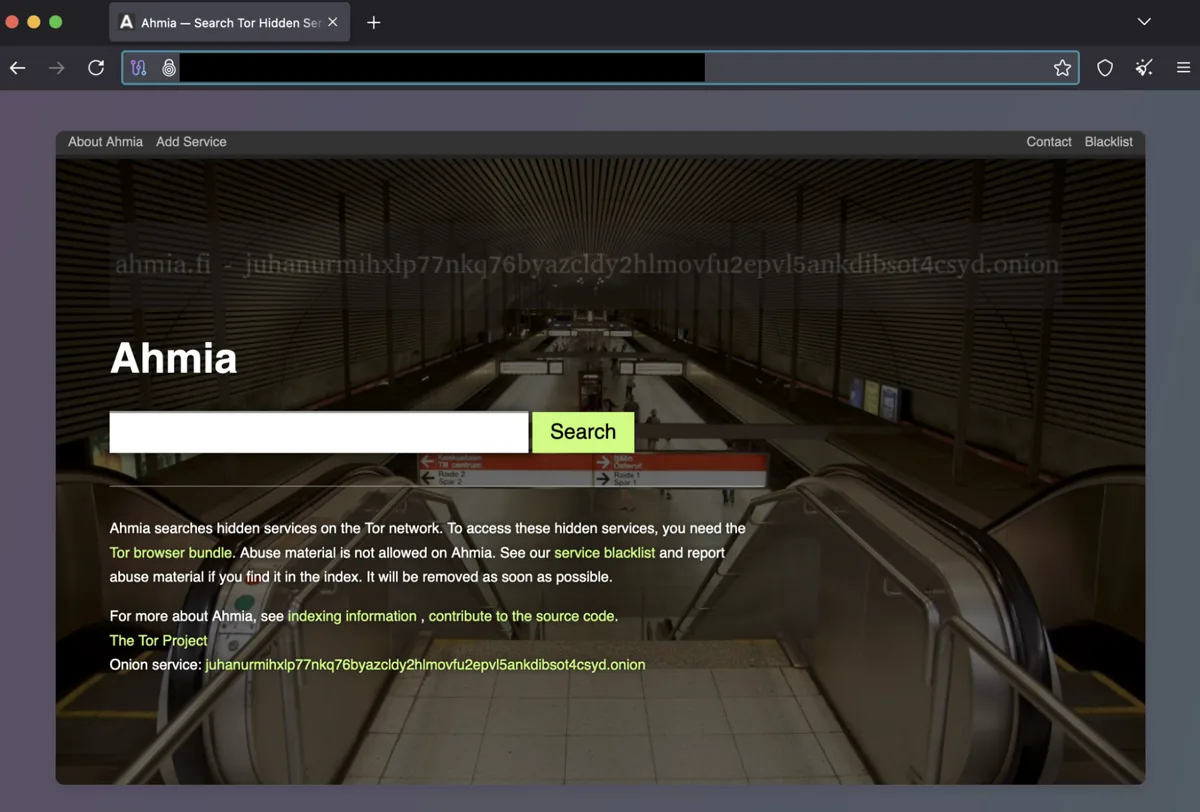
Ahmia's onion address is on ahmia.fi. Open the clearnet site first, over HTTPS, and take the address from that page. A copy that is already an onion, sent in a chat, is exactly what that warning exists to catch.
juhanurmihxlp77nkq76byazcldy2hlmovfu2epvl5ankdibsot4csyd.onion
Ahmia's about page carries a warning it shows when the host is not theirs: you are on a man-in-the-middle fake, and the instruction is to visit ahmia.fi to get the right onion. The check is the clearnet site, not a feeling that the search box looks familiar. The same page prints the start and the end of the real onion so you can compare. Compare all 56 characters. The first handful matching is how the fakes are built, which is the whole of how onion phishing works.
How an onion search engine differs from Google
Google follows links on the public web, and the sites want to be found. An onion address is not bought from a registrar. It is the service's identity public key, encoded into the hostname. There is no zone file to download. A Tor developer, ahf, wrote in March 2023 that version 3 stopped relays from enumerating the onion services they help connect, so sitting in the network is no longer a way to list them. The address contains a 256-bit key. Trying every value, he wrote, means counting to 2²⁵⁶, "an incomprehensibly large number," of which almost none are real services. His guess about how indexes get built anyway: people scan public data for strings that look like onion addresses.
That is what Ahmia is. Its terms, updated 25 September 2026, say it indexes and displays links to publicly accessible onion services and does not host their content. It also asks operators to submit a site. The about page links a crawler, and it publishes "all known non-banned onion domains." Known, and non-banned. Not every service that exists. A site that never links to itself from anywhere public, and that nobody submits, is absent. A site that was public in 2019 and died in 2020 can still be a row until something removes it. Both of those are why a result is not a directory of what is online tonight.
Can Google search the dark web? It can show you a clearnet page that mentions an onion address, because that page is on the public web. It cannot open the onion, and it does not maintain the index Ahmia does. The Tor Project's line is the short one: the host has to give you the address, because onions are not indexed the way other websites are. Pasting "dark web search" into Google returns articles about search engines. It does not return the onions.
What Ahmia filters, and what it stores
Ahmia blocks sites that contain child sexual abuse material. A policy it updated in October 2023 goes further on the query itself: searches it classifies as sexual are refused, and the page offers a self-help programme instead of results. An automated pass also strips links it flags as child-abuse material. The September 2026 terms say the filter can grow, and that a filtered search may show self-help resources or a research survey instead of results. Nothing on those pages says Ahmia removes drugs, markets or ordinary scams. A clean bill from the filter means the query was not in the sexual-abuse rules. It does not mean the result is a real newspaper, a real market, or a site that will still be up.
Do these search engines log what you search? Ahmia does, and it says so. The privacy policy dated 25 September 2026 lists search terms, which links you click, the browser's user agent, the referer and the time. It also says the logs do not contain IP addresses, that it uses no cookies, and that it builds no user profile. Read that as two facts. Your address is not in the log. The words you typed are. Searching for a named person, a leak, or your own project, on a box that records the query, is a choice. The IP being absent does not make the query absent. The same terms cover the onion and the clearnet.
Safest disables JavaScript on every site. Ahmia's homepage says, in its own spelling, that it has "not deployd" a non-JavaScript version yet. With scripts off, expect the shell of the page and no results. If you need Ahmia, you are choosing Standard or Safer for that tab, and you are running someone else's scripts on a search page. Do the search, take the address, leave. Don't stay logged into anything in that window, and don't drop the level because a result refuses to draw. A result that only appears after you lower the level is a result you should not be in a hurry to trust. What the dark web is, before any of these boxes, is the page for the map. This one is only the search.
How an onion gets into the index, and why so many never do
Ahmia has two doors, and neither of them is "the whole dark web." An operator can submit a site. The form's bargain is plain: adding the onion lets Ahmia's users find the service and its content, and child-abuse material will not be indexed and will be blacklisted. The other door is the crawler. The crawler's own readme says this is the software Ahmia uses to index onion domains. A crawler only walks what it can reach: a page that links to another onion, a submission, a string someone published. That matches ahf's guess from the Tor forum: indexes are built by scanning public data for strings that look like onion addresses, because the network itself will not hand over a list.
Ahmia's about page also says you are free to build your own index and crawler. There is no official onion phone book that Ahmia merely displays. "The best dark web search engine" is a fight between incomplete indexes. Ahmia is the one that will tell you its rules, its filter and its log. A second crawler, run by someone who will not say what they drop or what they store, is not a more complete version of the same thing. It is a second set of holes, plus a second person who saw your query.
Tor Browser's own search box is the mix-up that sends people to the wrong index. DuckDuckGo is the search engine Tor Browser ships, and Onionize only switches that search to DuckDuckGo's onion service. Type a query in the address bar and you are searching the ordinary web, over Tor. The results are websites with normal names. That is a Tor search engine only in the sense that the browser is Tor. It is not an onion search engine. If you wanted onions, open Ahmia. If the results look like Google's, you are not on Ahmia, and changing the security level will not fix the index. The address-bar search still works at Safest, because DuckDuckGo has non-JavaScript pages, and it still will not show you onion services.
Why the results include fakes and dead sites
Ahmia is an index of addresses it has seen, not a liveness probe you can treat as a review. Three different failures look the same in a results list.
- The site is gone. The string was public once. Nothing in the index has to re-check it before showing it to you. A click that never connects is the usual case, and it is the better failure.
- The site is a copy. A 2019 study of onion homepages found hundreds of domains whose front pages were near-copies of a service that already had an official address, including login pages that worked and did not share the real service's user database. A search engine that indexes public onions will index the copies too, unless a human has banned that particular address. How those copies get a prefix that looks right is the next page. The short version: the result is a lead.
- The site was never the thing the title claims. Anyone can put "official" in a page title and submit the onion to Ahmia, or leave the address where the crawler walks. Ahmia says it indexes publicly visible parts and is not responsible for their content.
Old lists make a fourth failure, and it is the one the vendor roundups still ship. A 16-character onion is the retired v2 format. Tor says that form no longer works. A "best engines" article that prints one has not been checked against the network you are about to use. Torch and Haystak are the names those articles have not retired. They do not appear in Ahmia's documentation or in the Tor pages above, and no operator page turned up where a reader could check an address or a privacy policy. A name in a top ten is not an engine. If someone hands you a Torch address, it has the same status as any other unsolicited onion: go looking for the operator on the clearnet, and stop when you cannot find them.
How to tell a search result is the real site
The box will sometimes lie to you, so check each result before you trust it:
- Prefer the organisation's own website. If the BBC, a newspaper or a software project is the thing you wanted, the address is on their site or in the directory that cites those sites. You did not need a search engine.
- If you did search, open the result only after you have the address from somewhere else to compare, or treat the result as a name you still have to verify. Ahmia's clone warning exists because a search page is a thing people counterfeit.
- Read all 56 characters. A shared beginning is the phishing pattern, not a check. The checksum inside a v3 address tells you the string is a well-formed address. It does not tell you it is the address you wanted. Both of those are spelled out on the scams page.
- A result that is a market, a mixer, or a "wiki" of links is the result you close. Those pages are where the clones in the 2019 study were earning. This site does not rank them, and a search engine that displays them has not reviewed them.
Use the DuckDuckGo onion when you want the ordinary web without handing the query to your provider, and Ahmia when the thing you are looking for only exists as an onion. Searching "dark web" in the DuckDuckGo onion returns web pages about the dark web, and the address bar will look like success. The index you queried is the wrong one.